

‘ Change does not happen in comfort zones ‘
— John Samuel
‘ Change does not happen in comfort zones ‘
— John Samuel

Human Resources Life Cycle or the Employee Life Cycle ,refers to the stages of an employees time in a particular organization and the shifting roles the Human Resources function play in each of those stages. It can also be defined as a concept in human resources management that describes the stages of an employee’s time with a particular company and the role the human resources department plays at each stage.
There are various stages to how the HR Cycle is viewed in various organizations , below are the stages :
The 3 stage Human Resources Cycle model:
The 4 stage HR Cycle model (1)
The 4 stage HR Cycle model (2)
The 5 stage HR Cycle model
The 7 stage HR Cycle model
The 8 stage HR Cycle model
As you can see they are all describing the roles HR play within the working life-span of the employee from pulling together job descriptions through recruitment, deployment, management, development and exit. The only real difference is the level of detail or focus in the various models.
In effect the HR Cycle is simply attaching the roles of HR to the stages employees journey through whilst they are in the company.
In relation to the above stated stated of HR cycle, below are the five core aspects to the human resources cycle.
1) Attraction, recruitment, selection
Attraction starts before the organization is even looking for a new employee. It encompasses the organization’s brand, and what shapes a potential employee’s overall perception of the company. As well as brand marketing, word-of-mouth plays a large role in shaping public opinion, and acts as a strong motivator or detractor.
Recruiting is about building a good candidate pipeline to ensure you have the best people available for each role. Success in selection is determined by much more than just the recruiter-candidate relationship, with your committed and loyal employees being your greatest champions.
2) Induction, orientation, on-boarding
During stage two, the employer and employee layout their expectations of each other. As a business, it is important to ensure the new employee feels inspired by their new role, becomes ingrained in company culture and settles within their team. Employees should feel welcome, valued and properly equipped to do their job right from day one.
What companies should work to avoid, is overselling the offer. Don’t make promises that you can’t actually deliver on, as employees quickly become dissatisfied if they’re not experiencing what they were sold.
3) Career planning and development
Once employee is established, the focus is on providing an opportunity for them to grow. A key part of this stage is how to deal with performance management. After each performance appraisal, company may want to reward employees in recognition of everything they’ve achieved, whether intrinsically or extrinsically. You can also offer individual or group incentives for the new goals you set.
From a business development perspective, you want to find ways to improve talent and boost productivity and revenues. HR teams should work to understand and identify potential and actual specialist skills, interests and talents that they have within the business, and use this information when looking for ways to help those employees grow.
4) Retention
There’s a lot of time and money invested in the cycle for each employee – losing someone means that the entire process must start again. So ensuring that you are able to retain talent past stage three is important.
In terms of the day-to-day, the best way to retain good employees is to give them the tools, environment and skill set they need in order to do their job effectively. When this doesn’t happen, employees become frustrated and the organization loses high-performing, specialized talent.
Looking further ahead, organizations must create a culture where employees feel confident that they know where they’re going and what their purpose is. Career pathways should be well-defined with a sense of transparency.
5) Separation and termination phase
For many, this stage is simply a paper-pushing exercise that ticks HR boxes – but it can be extremely valuable when executed effectively.
Understanding why employees leave is a key part of retaining the best people going forward. Having a conversation about their choices early in the exit process also promotes a positive atmosphere, and helps to leave the door open for good employees to return and ultimately continue recommending your organization to others.
How can organizations improve their human resources cycle?
While the overall stages of the cycle remain largely the same, how it’s implemented varies largely according to in-house resources and organizational approach. Small organizations may not have an in-house HR team to manage the cycle, while a large company may have a big HR department but be bound by budgetary constraints.
However, all organizations can be proactive in doing what they can to improve their existing employee life cycle and should consider:
CASE 1
This was a case of financial misconduct from the top of the chain of command of the board of directors of Wells Fargo. This was a clear case of fraud and unethical working procedures.
The aftermath of this resulted to about 5300 employees getting fired due to making fake bank accounts without the knowledge of their customers yet using customer information
However ,Wells Fargo was fined €185M as fined with €5M refund to customers.
Wells Fargo pressurized their employees to meet up with 5 times highers sales than usual . Former workers said they had an internal goal of selling minimum 8 financial products to each customer even knowing these actions were illegal especially creating fake accounts , the employers knew about these unethical actions yet turned a blind eye to it.
CASE 3
This is in regards to case when but more about employee’s testimonies on how they were forced to open fake accounts with fake credentials etc
There was a case of a former employee who refused to open phony bank accounts. Then had to call ethics hotline ( Ethics hotline is WF’s internal tool to provide refuge to employees in dangerous work environment and to prevent illegal activities) and notified the HR via emailed . When this employee did the require thing then 8 days later he was fired claiming ”tardiness” as an excuse.
Another case was a former HR official said they had processes against whistle-blowers even though Suppressing whistle-blowers is against the law.
The CEO was questioned by Senator Elizabeth Warren at the Senates committee though he failed to give credible information nor complied to answering questions
CASE 4
This article tells also that other banks were involved in similar scandals hence pressuring their employees to increase sales at any costs. Also there was a staggering of over 31 thousand complains from customers about phony activities happening with their credentials and bank accounts.
In addition , cross selling is the way for banks to create more profit meaning if you open a cheque account they will ask if you want a debit card like the way it works in fast foods like example McDonald if you order Hamburger they ask if you want fries.
CASE 7
This was the case where WF made employees to work over time . Allegations that Wells Fargo violated federal law requiring overtime pay for hourly workers go beyond the Fake-account scandal. So-called “wage theft” complaints and related class action lawsuits go back to 1999, according to US Senator who requested the Labour department investigate whether the company “aggressively skirted overtime laws.”
Meanwhile the labour department investigate WF for wage theft, also checking older lawsuits back to 99′. It means that hourly employees who did not meet the sales goals had to work for free overtime until they reach them
CASE 9
Wells Fargo’s chief executive, John Stumpf, is to resign immediately in the wake of a scandal over its sales practices, the bank has announced while will be succeeded by the bank’s current president and chief operating officer, Timothy Sloan.
The bank’s independent chairman, Stephen Sanger, take over as board chairman.
Nevertheless , investigation on the fraud was in progress to bring to justice the illegal fraudulent practices within the bank.
Reflective writing
After going through all the cases i find it extremely appalling that most of the board of directors were not jailed or made to pay heavier fines even though only the company can be fined. I believe this was systematically don to avoid jail sentences rather would see the company plunge but remain unaffected.
It was completely unethical to begin with to force employees to increase sales and an outrageous level , completely illegal to create fake accounts and most definitely illegal to use customers data without their consent violating their privacy.
I think judgement was not served properly even when one of the top executive has to retire with $124M meaning even after all her actions and damages done , she still gets out rich.
Sources
CNN (2016 ):I called the Wells Fargo ethics line and got fired. URL: http://money.cnn.com/2016/09/21/investing/wells-fargo-fired-workers-retaliation-fake-accounts/index.html Accessed 03.05.2020
CNN (2016 ): Horror stories from former Wells Fargo employees. URL: http://money.cnn.com/2016/09/09/investing/wells-fargo-phony-accounts-culture/index.html Accessed 03.05.2020
CNN (2016 ): Wells Fargo’s culture is widespread in banking. URL: http://money.cnn.com/2016/09/22/investing/wells-fargo-fake-accounts-banks/index.html Accessed 03-05.2020
CNN (2016 ): Wells Fargo boss John Stumpf steps down. URL: http://www.bbc.co.uk/news/business-37639648 Accessed 03.05.2020
CNN (2016 ): Wells Fargo made me work overtime without extra pay. URL : http://money.cnn.com/2016/09/30/investing/wells-fargo-workers-wage-theft-overtime/index.html Accessed 03.05.2020
Brink,E (2019): How can organizations improve to ensure employees have the best possible experience? URL : https://www.hcamag.com/nz/specialisation/employee-engagement/5-stages-of-the-hr-cycle/172840 Accessed 03.05.2020
The Oxford Review ( 2016 ): Human Resources Cycle : Comparison of models . URL : https://www.oxford-review.com/oxford-review-encyclopaedia-terms/human-resources-cycle/ Accessed 03.05.2020
Thomson,S (2019): Human Resources Life Cycle . URL : https://smallbusiness.chron.com/human-resources-life-cycle-62078.html Accessed 03.05.2020
Wright,J (2017) : The 12-Step Process That HR Needs for Unleashing the Full Potential of Their Workforce : URL : https://www.eaglesflight.com/blog/the-12-step-process-that-hr-needs-for-unleashing-the-full-potential-of-their-workforce Accessed 03.05.2020

Exit Management is a process to manage the full and final settlement of employees when they exit from an organization. This however applies to both employees who have resigned voluntarily and those that have been terminated by the company through a layoff or dismissal .
It is imperative for a company or business enterprise to have a clear process to follow during Employee Exits which will ensure you protect your business and its assets, and help the Employee leave with dignity. It is also a great time to get feedback from them about their time at your place
The following guidelines could be implemented to aid employee exit :
In addition to the above stated topic, ‘ Exit Management ‘ we discuss in details about Employee Separations .
Just as Exit Management is defined , Employee Separations also can be defined as , ‘ when an employee decided not to be a member of an organization ‘.
In this case scenario , often times companies tend to check the ‘turn over rate ‘ in relation to how many employees resign. This means that they would need to minimize the turn-over and costs of replacing employees. For example the cost of replacing a highly skilled employee maybe be very high when considering the revenue and the turn-over of the company affording to pay a new skilled employee.
The Cost of Employee Separations
Separation cost is defined as the cost to separate or layoff employees in an organization.
Estimates vary, but experts agree that the cost of terminating an employee is considerable. There are many direct and indirect expenses connected with termination (more on that below) — most significantly, the costs involved in filling a newly opened position. A 2016 report from the Society for Human Resource Management (SHRM) found that the average expense to bring on a new worker is $4,129, requiring approximately 42 days to get the position filled.
Below we discuss various forms of costs related to Employee separation costs.
RECRUITMENT COSTS
This is the total amount spent to recruit or hire a professional to join an organization or cost of recruiting a replacement. In other words, it can also be termed as cost per recruitment or placed candidate. The analysis of recruitment cost is necessary for profit analysis of an organization or a company. Most recruiters are not aware of this and that is why they can not determine whether their recruitment was effective or not.
These costs may include advertising the job vacancy or using professional recruiting agency(s) to travel to various locations etc
SELECTION COSTS
This more related to selecting process , hiring and also placing a new employee in a job. The entire process which also includes interview comes at a cost which may include to travel to sites of the interview , the arrangement and time used to organizing the interview and also organizing the meeting to making the selections and decisions.
TRAINING COSTS
Hiring a new employee isn’t the end of the road because a new employee would need to settle down to understanding work duties and all and this entails trainings and it costs the organization as well because training new employees is a necessary part of on-boarding.
Organization must invest time and money into making sure a new hire understands their job responsibilities. Improper training can lead to sloppy work or eventual employee turnover, which means repeating the whole process.
According to Association for Talent Development’s 2016 State of the Industry Report’ The average training cost per employee is $1,252 ‘.
SEPARATION COSTS
Separation costs are the costs an employer incurs during the process of terminating an employee, including severance pay, costs associated with unemployment insurance claims, the expense of continued benefits etc.
What many employers forget to include in their estimates of separation costs, however, is the time other employees spend processing the employee’s termination, including removing the employee from payroll or benefits systems, conducting exit interviews, etc.
In some cases some employees may continue to receive health benefits until they find a new job. Other costs incurred may included administration itself which includes exit interviews . This interviews are conducted to deduce why the employee was leaving and feedback are important for the company to update polices and improvement for the organizations as a whole.
THE BENEFITS OF EMPLOYEE SEPARATION
However , in contrast to the costs of employee separation, but on the other hand there are some resulting benefits too. Following are some of the Employee benefits that are associated with the employee separation.
TYPES OF EMPLOYEE SEPARATION
Employee separation can be classified into two , Voluntary ( which relates with employees ) and Involuntary ( Which is initiated by employers ).
Voluntary Separations
A voluntary resignation is when an employee himself/herself decides to resign on the grounds of ill health, marriage, better job prospects in other organizations ( personal or professional ) etc.
This decision could be maybe employee has found a better job , better salary , Change in career , seeking more quality time with family etc and it could also be maybe the working environment is not conducive anymore or low pay benefits , bad relationship with employer etc
RETIREMENT
Retirement can be characterized as one of the the major cause of separation of employees from the organization. It can be defined as the termination of service of an employee on reaching the age of superannuation. For example, According to Central Universities, ‘ At present the superannuation age for the teachers working in the Central Universities is 62 years and in case of some state government employees, it is 58 years. Some people characterize retirement as ‘role less role’.
However Retirement can also be classified into two:
This is the retirement when employees retire compulsorily from service on attaining the age of superannuation. Some organizations like Universities may have a policy to reappoint professionals and others who possess rare skills and expertise for a limited time even after attaining superannuation.
When organizations give option to its employees to retire even before superannuation, it is called ‘voluntary retirement’. This scheme is termed as, ‘voluntary retirement scheme (VRS)’. Of late, in their efforts to downsize the employees, organizations by providing certain incentives, are trying to encourage their employees to opt for voluntary retirement.
INVOLUNTARY SEPARATIONS
This occurs when an organization or management decides to terminate the contract of it’s employee due to either economic reasons or poor fit between the employee and the organization.
There are various forms of Involuntary separations :
Discharge or Constructive discharge : This occurs when management discovers employee is not fit for the job task or cannot meet up with work standards or has poor performance . Also it could be that employee engaged in misconducts or actions that goes against company policies like theft or dishonesty which is liable to immediate termination
Layoffs : When organization experience low demand of products , they often tend to layoff employee just to cut costs. Layoffs can also refer to a separation in which the employer has let an employee go because their services are no longer needed. Layoffs occur when employers experience a reduced volume of business or funding, or when a reorganization occurs that renders a job unnecessary. Economic changes, financial decisions, restructuring, redundancy, attrition, or a change in function may lead to this kind of separation from employment.
CASE 1 AND 2 : Nokia closes plant in Germany and relocates in Romania AND Nokia cuts 3500 jobs “to ensure profitability”
This was a case of Nokia making drastic decision disregarding consequences of of laying off employees to choosing to relocate factory to Romania just to simply cut costs .
However this decision comes at a serious cost because this means that 4000 jobs will be abolished hence 4000 people will be laid off leading to loads and loads settlements to be made by Nokia to all the employees who lost their jobs.
Nokia will on the other hand spend a lot of money to advertise new job positions in Romania , research on new positions , spend money to hire new people , spend money on interviews , training new workers and also consider the company’s revenue to replace experts laid off in Germany to hire new ones in Romania.
Also the same scenario happened that 4 years later Nokia decided to close the factory in Romania and also considering closing Hungary, Mexico and Salo and some places in Finland.
These factory shut downs and employees being laid off was definitely affecting Nokia but the executives stated that job cuts are intended to ensure the company remains profitable both now and in the future.
CASE 3 : Hundreds of Nokia’s outsourced Symbian developers leaving Accenture
This was a case of severance packages . Nokia employees were outsourced to work for Accenture with a severance package but considering the state of situation with Nokia , it turned out that these employees are seeking for the severance package as they were willing to terminate their contracts.
Actions like these puts Nokia even into deeper financial issues as they will not only pay these employees ( 15 months agreed ) but then again will still have to invest to hiring new employees and also go through he process of training etc

Strategic planning is the art of formulating business strategies, implementing them, and evaluating their impact based on organizational objectives. The concept focuses on integrating various business departments (accounting and Finance research and development, production, marketing, information systems, management) to achieve organizational goals. The term strategic planning is synonymous with strategic management, only that the former is used in the corporate world and the latter in the academic setting.
In order to improve the strategic alignment of staff and other resources, it’s essential to understand how a strategic HR planning process works. At its most basic level, strategic human resource planning ensures adequate staffing to meet your organization’s operational goals, matching the right people with the right skills at the right time.
Below are four steps HR could follow to make strategic planning.
The first step in the human resource planning process is to assess your current staff. Before making any moves to hire new employees for your organization, it’s important to understand the talent you already have at your disposal. Develop a skills inventory for each of your current employees.
Once you have a full inventory of the resources you already have at your disposal, it’s time to begin forecasting future needs. Will your company need to grow its human resources in number? Will you need to stick to your current staff but improve their productivity through efficiency or new skills training? Are there potential employees available in the marketplace?
After determining your company’s staffing needs by assessing your current HR capacity and forecasting supply and demand, it’s time to begin the process of developing and adding talent. Talent development is a crucial part of the strategic human resources management process.
Once your human resource management process plan has been in place for a set amount of time, you can evaluate whether the plan has helped the company to achieve its goals in factors like production, profit, employee retention, and employee satisfaction. If everything is running smoothly, continue with the plan, but if there are roadblocks along the way, you can always change up different aspects to better suit your company’s needs.
Human Resource Management : The Challenges

Human resource management (HRM) is adopted by many companies because of its benefits. But at the same time, various challenges and issues may emerge in front of managers of human resource department while performing their duties.
Below are few challenges the HR face :
Recruiting New Staff : Companies sometimes need to recruit new talent for various reasons such as an increase in project scope, operations. While recruiting, HRM faces major challenges i.e. selecting the best candidate and making the hired candidate familiar with the environment and culture.
Retention : Hiring employees is not only the challenge that HRM faces; retaining them is also one. Retention of employees is essential to minimize employee turnover rate.
Training : Skilled workers are the key to the smooth functioning of the organization. Therefore, HRM should manage on-site (within the workplace) as well as off-site (outside the workplace) job training for employees.
Productivity : Maximizing profit and minimizing cost is the essence of productivity. Higher the productivity level, more successful will be the company. HRM should always focus on maintaining high productivity level.
Globalization : Globalization is a process by which a business firm or organization starts operating on an international scale, creating international influence.
Human resources outsourcing involves hiring companies to manage personnel functions, including the administration of health benefits, retirement plans, and workers’ compensation insurance. It also includes hiring, training, and legal expertise.
ADVANTAGES OF HR OUTSOURCING
DISADVANTAGES OF HR OUTSOURCING
CASE : Child refugees in Turkey making clothes for UK shops
This was the case of human rights, exploitation and child labour. These companies Zara,Mango, Asos, Next , Marks and Spencer were found to have used children to work below minimum wage. Issues like these are very common when big companies don’t spend resources to do reports on their supply chain and most especially product sites.
The case of Marks and Spencer was made public when Panorama investigated factories in Turkey and found children had been working on clothes for Marks and Spencer and the online retailer Asos.
Obviously these company’s PR will deny actions like these but fact is it has been proven so many times that most of these companies often indulge in child labour to cut costs and maximize profits and that is why it is mandatory for companies with production sites offshore to do situation reports and ensure that there are no cases of child labour or employee exploitation .
References:
In-text reference : ( Amadeo , K . 2019 ) List of reference : Amadeo , K . 2019. Human Resources Outsourcing and Its Effect on the U.S. Economy. URL : https://www.thebalance.com/human-resources-outsourcing-effect-on-economy-3306256 Accessed 20.04.2020
In-text reference: ( Andriotis,N. 2018 )List of reference : Andriotis,N. 2018 . The Top 7 HR Challenges and How To Face Them. URL : https://www.efrontlearning.com/blog/2017/11/top-7-human-resource-challenges-solutions.html Accessed 20.04.2020
In-text reference: ( Doyle, A . 2018 ) List of reference : Doyle,A . Types of Separation from Employment. URL : https://www.thebalancecareers.com/types-of-separation-from-employment-2061665 Accessed 20.04.2020
In-text reference: (Gomez-Mejia, Balkin and Cardy 2016) List of references: Gomez-Mejia, L.R., Balkin, D.B. and Cardy, R.L. 2016. Managing Human Resources. Global Edition 8/E. Pearson. London. ISBN-10: 1292097248 • ISBN-13: 9781292097244. URL: http://ezproxy.haaga-helia.fi:2048/login?url=http://www.dawsonera.com/depp/reader/protected/external/AbstractView/S9781292097244 Accessed 15.03.2020
In-text reference : ( Jahan,S 202O) List of reference: Jahan,S. 2020. Processes for Employee Exit.URL : http://hrmpractice.com/processes-for-employee-exit/ Accessed 20.04.2020
In-text reference : ( Lewis,D. 2018 ) List of reference : Lewis,D.2018. The pros and cons of outsourcing HR. URL : https://www.peoplemanagement.co.uk/experts/legal/pros-and-cons-outsourcing-hr Accessed 20.04.2020
In-text reference: ( Maharjan,P. 2018). List of rerence: Maharjan,P. 2018. Challenges and Issues in Human Resource Management. URL : https://www.businesstopia.net/human-resource/challenges-issues-human-resource-management Accessed 20.04.2020
In-text reference : ( Munyiri,I,N. and Njagi,S,W.2014) List of reference: Munyiri,I,N. and Njagi,S,W.2014. A Critical Analysis of the Employees Separation Management Procedures with Regard to Organizational Stability in Kenya. URL : https://www.semanticscholar.org/paper/A-Critical-Analysis-of-the-Employees-Separation-to-Njagi-Munyiri/32aa060e593a1c0e142647b12d664df3421e7078 Accessed 20.04.2020

Before we can discuss about employee well-being and health and safety at work, first of what is well-being ?
Well-being is a state of mind of being with positive outcome that is meaningful for people and for many sectors of society, the perception is that their lives are going well. Good living conditions (e.g., housing, employment) are fundamental to well-being.
The goal of well-being at work is to keep employees healthy and able to work throughout their careers. The purpose of a workplace’s occupational health and safety (OHS) activities is to improve working conditions – to prevent and fix deficiencies and help solve work-related problems. Occupational health and safety is a part of management. A good quality of working life and a healthy work community have a positive impact on productivity.
According to Bureau Of Labour Statistics , it indicates that approximately 3 million people were injured on the job 2011 and 2012, 4,383 workers died. So far there has been a decline in fatalities and injuries in on-the job in the United States and part of the reasons is due to improved safety and health conditions in workplaces and also it could also be as a result of fewer hours worked in industries that have a high incidence of worker injuries and fatalities such as constructions.
All government parastatal have passed laws to regulate safety in workplace and many of these laws entails detailed regulations regarding work hazards in some industries such as coal mining and rail roads.
In order to create a binding law that protects workers in work-places , two sets of work safety Law to protect workers in work-place were made even though the objectives, policies and operations of these two sets of laws are very different :

WORKER’S COMPENSATION
During the early 1800s, people without medical care who got injured during work were left to tend to their injuries themselves and did not receive any compensation and would only get paid when they resume work. Also employees who sued their employers had little or not chance of winning at all . Also under the fellow-servant rule, it was quoted that, ” employers were not responsible for an employee’s injury when the negligence of another employee contributed to or caused the injury
During the early years of the twentieth century , after several workplace disasters and including the famous tragedy in 1911 , a fire incident in New York shirt factory killing more than 100 women , incited the pressure on several state legislatures to enact worker’s compensation law. This law was based on a theory that work-related accidents and illnesses are costs of working for the employers and employers should pay for the costs. This compensation program has been in practice since 1948 .
According to a report written by saylordotorg , the goals for workers compensation laws are:
Coverage under workers’ compensation is either inclusive or exclusive. Further, it is compulsory or elective, depending on state law. A major feature is that only injuries and illnesses that “arise out of and in the course of employment” are covered.
To limit benefits to situations in which a definite relationship exists between an employee’s work and the injury, most laws provide coverage only for injuries “arising out of and in the course of employment.
Workers’ compensation laws provide for four types of benefits: medical, income replacement, survivors’ benefits, and rehabilitation.
All laws provide unlimited medical care benefits for accidental injuries. Many cases do not involve large expenses, but it is not unusual for medical bills to run into many thousands of dollars.
BENEFITS OF WORKER’S COMPENSATION
Marianne Bonner stated that , ‘ A worker’s compensation policy affords benefits to injured employees as prescribed by the applicable state law. Virtually all states provide four types of benefits: medical coverage, disability benefits, rehabilitation, and death benefits ‘.
These benefits are :

The Occupational Safety and Health Administration (OSHA) is a national public health agency that is part of the United States Department of Labor. OSHA was established under the Occupational Safety and Health Act, which was signed into law on December 29, 1970.
OSHA’s PROVISIONS
OSHA makes three distinctive obligatory rules for employers to follow :
THE OCCUPATIONAL SAFETY AND HEALTH ADMINISTRATION
The Occupational Safety and Health Administration has a sole duty of enforcing OSHA and there duties entails developing the following :

SAFETY AND HEALTH PROGRAMS
According to the U.S. Bureau of Labor Statistics,’ the rate of worker deaths and reported injuries in the United States has decreased by more than 60 percent in the past four decades since the Occupational Safety and Health (OSH) Act was passed. However, every year, more than 5,000 workers are killed on the job (a rate of 14 per day), and more than 3.6 million suffer a serious job-related injury or illness”.
However in order to reduce the mortality rates at workplaces especially in hazardous places and factories , employees are tasked to give safety guidelines which entails safety programs meant to teach and educate employees about safety and taking other necessary measures and precaustions and these guidelines could be in form of :
EXAMPLES OF CASE STUDIES
This is a case of a young and aspiring student who got a job in one of the biggest telecom company in the world and could have being tasked with loads of works to do which he may have wanted to impress his boss by sacrificing his wellness but ends up dying for it.
A young Google software engineer died at his desk Friday night in the company’s New York headquarters.
News sources say 22-year-old Scott Krulcik was found unconscious at his work terminal at approximately 9 p.m. by a janitor. Emergency responders performed CPR but were unable to revive Krulcik. He was pronounced dead at the scene.
Authorities say there were no signs of physical trauma and no indications of a criminal act. Krulcik’s death is being investigated by the New York City Medical Examiner. News sources say Krulcik had no history of health or substance abuse problems.
The Carnegie Mellon University graduate interned at Google several times before being hired full-time after graduating with a degree in computer science.
2. Japanese woman ‘dies from overwork’ after logging 159 hours of overtime in a month
Japan has again been forced to confront its working culture after labour inspectors ruled that the death of a 31-year-old journalist at the country’s public broadcaster, NHK, had been caused by overwork.
Miwa Sado, who worked at the broadcaster’s headquarters in Tokyo, logged 159 hours of overtime and took only two days off in the month leading up to her death from heart failure in July 2013.
A labour standards office in Tokyo later attributed her death to karoshi (death from overwork) but her case was only made public by her former employer .
References:
In-text reference: ( Bonner,M.2018) List of references: Bonner Marianne. Workers Compensation Benefits. URL : https://www.thebalancesmb.com/types-of-workers-compensation-benefits-4047799 Accessed 05.04.2020
Canadian Center for Occupational Health and Safety. Employee Assistance Programs (EAP): https://www.ccohs.ca/oshanswers/hsprograms/eap.html Accessed 05.04.2020
Canadian Center for Occupational Health and Safety. Health and Safety Programs: https://www.ccohs.ca/oshanswers/hsprograms/ Accessed 05.04.2020
In-text reference: (Gomez-Mejia, Balkin and Cardy 2016) List of references: Gomez-Mejia, L.R., Balkin, D.B. and Cardy, R.L. 2016. Managing Human Resources. Global Edition 8/E. Pearson. London. ISBN-10: 1292097248 • ISBN-13: 9781292097244. URL: http://ezproxy.haaga-helia.fi:2048/login?url=http://www.dawsonera.com/depp/reader/protected/external/AbstractView/S9781292097244 Accessed 15.03.2020
Ishn,2018. 22-year-old Google employee dies at work. URL : https://www.ishn.com/articles/109928–year-old-google-employee-dies-at-work Accessed 05.04.2020
JHL, 2020. Occupational health and safety and well-being. URL : https://www.jhl.fi/en/atwork/basics-working-life/occupational-health-safety-well/ Accessed 05.04.2020
Saylor Academy,2012. Risk Management for Enterprises and Individuals. URL : https://saylordotorg.github.io/text_risk-management-for-enterprises-and-individuals/s20-01-workers-compensation-laws-and-.html Accessed 05.04.2020
The Guardian,2018.Japanese woman ‘dies from overwork’ after logging 159 hours of overtime in a month. URL : https://www.theguardian.com/world/2017/oct/05/japanese-woman-dies-overwork-159-hours-overtime Accessed 05.04.2020

According to Kevin Kruse, Employee engagement is the emotional commitment the employee has to the organization and its goals.
However ,definitions of employee engagement range from the brief and concise to the descriptive and detailed. Many of these definitions emphasize some aspect of an employee’s commitment to the organization or the positive behaviors an engaged employee exhibits. Examples of employee engagement definitions include:
Quantum Workplace – Employee engagement is the strength of the mental and emotional connection employees feel toward their places of work.
Gallup – Engaged employees as those who are involved in, enthusiastic about and committed to their work and workplace.
Nowadays, employees are expected to put 120 % of the time devoted to their careers. It comes as no surprise that they become complacent and agitated when the opportunity for professional growth lacks. In fact, a recent survey found that when employees lack this opportunity it contributes to low engagement and high employee turnover. What employees want is to improve their skills and broaden their knowledge. At the end of the day, the recognition of professional development is a huge motivational factor.
The main concern of business leaders is to increase productivity, output, and innovation. However, they should understand that it is difficult to make this happen when employees are not on the same page. In fact, when employees feel they are not fully committed and enthusiastic about their work, it’s up to the manager to understand why this is so. Hence, a superior approach would be to understand what motivates and drives employees in the workplace.
Employee engagement is likely to occur when employees know what to do, and when they want to do it. In fact, the engagement process is a partnership, whereby employees and leaders must mutually engage to grow the business. Hence, organizations need to look further than the bottom line and engage with employees to get the most out of their productivity. Employees should be considered as the main asset of any business. Having a successful organization requires a bit more than just focusing on making a profit. Not having actively engaged employees can have detrimental effects on the organization. Therefore, companies make engagement happen by fully aligning the business strategy with the talent strategy.
It is essential for managers understand where they stand with their employees. Through such feedback, leaders can understand how their subordinates see them, and where they can improve. Hence, by soliciting manager feedback conversations, it ensures that employee engagement remains high, as employees have the freedom to express exactly how they see the manager and where they fall short. Hence, the key to addressing the concerns of employee engagement is through communication, and by constantly asking, companies can solve engagement issues before they hinder the company’s success.
One of the most effective methods to increase employee engagement is through training. Without good training and development opportunities, employees’ performance can be negatively impacted: 23% of employees leave their jobs due to the lack of training and development opportunities and 58% of staffs feel that they are not reaching their full potential due to the lack of skills and relevant qualifications. Therefore, training comes as a valuable means to resolve such situations. Today, with advanced technologies, new forms of e-learning such as scenario-based videos, webinar, simulation, and gamification are increasingly being implemented and used by global corporations. For instance, companies who use online training technology achieve 18% boost in employee engagement.
Acknowledging the accomplishment of employees will lead a boost in motivation. This will allow the staff to give their best in their jobs. Hence, resulting in better employee engagement within the organization. Therefore, employers will benefit from increased productivity and profitability as employees will feel that their efforts are being appreciated.

Employee engagement has become a focal point in today’s workforce because companies are finally beginning to grasp that in order to keep your customers happy, you need to have happy, engaged employees.
But, according to research by Gallup, only 33% of employees in the USA were engaged in 2016 – “involved in, enthusiastic about and committed to their workplace”
Engaged, motivated workers have higher employee satisfaction, which leads to enthusiasm in their role and overall company growth in the form of higher retention and lower turnover; higher productivity; increased profitability; less absenteeism, and increased employee loyalty.
Employee satisfaction is key in any company, and when employees are not satisfied with their job, they lack enthusiasm about the day to day of their role and the growth of their companies at large.
Low job satisfaction becomes a drain on the company’s time and money.
When employees are engaged at work and feel satisfied with their position, they feel a greater connection to the company and are therefore more likely to produce quality work, which benefits the company as well as the customer.
The hiring and on-boarding process for new employees is very expensive and time-consuming.
Another benefit of investing in employee engagement is that it will help you retain your top employees and decrease your turnover rates by ensuring that your team is happy.
Engaged employees work faster, harder and stronger because they like what they do. It’s a no-brainer; when you’re interested in and connected to what you’re doing, you are more likely to do it well.
Furthermore, when employees are engaged and feel that they are treated well by their managers, they will feel a sense of responsibility to reciprocate this respect by putting in their best effort.
Of course, when your employees feel good at work, they work harder, and when they work harder they produce more quality work which in the end points to a happy customer. Happy customers keep coming back and they refer other people to your company.
It’s such a simple way to increase your company’s profitability but so many organizations keep looking outward instead of turning inward. Without a solid foundation, no company can thrive and the best way to ensure this sturdy base is to have an engaged team.
Engaged employees show up to work and once there, they get more work done. Highly engaged businesses in the USA have realized 41% reduction in absenteeism
The issue with disengaged employees is that they don’t feel a sense of responsibility to the company they work for, so they don’t have a problem not showing up.
Engaged employees feel that they are part of the organization they work for, and therefore would not want to let them down.
A huge benefit of having engaged employees is that they are loyal to your company and therefore act as company ambassadors.
In order to find out whether or not your employees feel loyal to your brand, you can use the Employee Net Promoter Score (eNPS).
Originally, this scale was used to measure customer loyalty, but it became apparent that understanding how employees feel about their company would affect how customers feel about it too.
The first way to keep your employees is to onboard them properly.
Employees who go through a structured on-boarding are 58% more likely to be with the organization after three years, but sadly, 22% of companies currently do not have a formal on-boarding system.
One of the most important ways to engage your employees is to constantly communicate with them.
They want to improve, so offering them frequent feedback on their work, and that includes constructive criticism, is greatly appreciated and will keep them working towards the achievement of their goals.
Offering solely annual performance review is problematic. They don’t allow for constant progression, and it will only instill fear in your employees, which ultimately disengages them.
Monthly one-on-ones and frequent check-ins are the best way to keep employees interested, motivated and engaged.
It’s extremely important to build a culture of employee recognition and offer praise to your team.
When employees feel valued, recognized and appreciated for their hard work, they want to continue to do a good job for their company.
To keep your employees engaged, they need to feel as though there is room for them to grow personally and professionally within the organization.
Investing time and money in their personal growth lets them know that you see them as a valuable, long-term members of the team.
Results from the Harvard Business Review’s 2013 employee engagement survey reveal that 70% of people surveyed say that they are most engaged when senior leadership continually updates and communicates company strategy.
Why? Because they feel part of the bigger picture, working towards a collective end goal. They will feel grateful for being kept in the loop, important to the team, and aligned with the company vision.
CASE STUDY OF SUCCESS STORY OF EMPLOYEE ENGAGEMENT
With a captivating presentation filled with honesty, Chris Ebbeler Director of Social & Community Engagement at Chili’s, gave a unique perspective on employee engagement in the restaurant industry.
As a brand approaching its 50th anniversary, Chili’s has weathered many ups and downs. After the great recession in the US, Chili’s knew they needed to strengthen their vision and mission and start focusing on employee engagement. Their revived purpose is, “We connect, serve and give to create the best life.”
Chili’s has recognized that the idea of work-life balance is different than what it used to be. With the rise of technology, work and home are now connected. In order to create a great place to work, they had to honor the fact that people now bring their whole selves to the office. Ebbeler says, people now want to work somewhere that represents their lifestyle. To the crowd’s applause, Ebbeler shared the story of how Chili’s dissolved their “no visible tattoo” policy. He added, “People want to bring their whole self to the workplace – so let ‘em.”
Employee engagement has gone up for Chili’s since 2010; now 75% of people at Chilis are engaged at work. Ebbeler shared a quote from Simon Sinek on why this is important, “Customers will never love a company until the employees love it first.”
Ebbeler offered these tips on building an engaged workforce:
References:
In-text reference: ( Croswell,A). List of reference: Croswell Alexis. Three stories about employee engagement. URL: https://www.cultureamp.com/blog/key-learnings-from-the-employee-engagement-awards/ Accessed 16.03.2020
In-text reference: (Dale Carnegie & Associates, Inc.2018). List of reference: Dale Carnegie & Associates, Inc.2018. Employee Engagement: It’s Time to Go ‘All-In’. URL:https://www.dalecarnegie.com/en/resources/employee-engagement-making-engagement-a-daily-priority-for-leaders/thank-you Accessed 16.03.2020
In-text reference: (Gallup, Inc.2017). List of reference:Gallup, Inc.2017. State of the American Workplace. URL: https://news.gallup.com/reports/199961/7.aspx Accessed 16.03.2020
In-text reference: (Gomez-Mejia, Balkin and Cardy 2016) List of references: Gomez-Mejia, L.R., Balkin, D.B. and Cardy, R.L. 2016. Managing Human Resources. Global Edition 8/E. Pearson. London. ISBN-10: 1292097248 • ISBN-13: 9781292097244. URL: http://ezproxy.haaga-helia.fi:2048/login?url=http://www.dawsonera.com/depp/reader/protected/external/AbstractView/S9781292097244 Accessed 15.03.2020
In-text reference: (Hastings, R.2009). List of reference:Hastings, R.2009. The “what” and “why” of employee engagement. URL: https://www.shrm.org/resourcesandtools/hr-topics/employee-relations/pages/whatandwhy.aspx Accessed 16.03.2020
In-text reference: ( Harvard University ). List of reference: Harvard University. The Impact of Employee Engagement on Performance. https://hbr.org/resources/pdfs/comm/achievers/hbr_achievers_report_sep13.pdf. Accessed 16.03.2020
In-text reference : (Kappel,M.2018). List of reference: Kappel Mike.How To Establish A Culture Of Employee Engagement.URL: https://www.forbes.com/sites/mikekappel/2018/01/04/how-to-establish-a-culture-of-employee-engagement/#5d8e603c8dc4 Accessed 16.03.2020
In-Text reference: (Kruse,K.2012). List of reference: Kruse Kevin,2012. What Is Employee Engagement. URL : https://www.forbes.com/sites/kevinkruse/2012/06/22/employee-engagement-what-and-why/#3b8acbd47f37 Accessed 16.03.2020
In-text reference: (Robins,A.2017). List of reference: Robins Alison.2017.6 Amazing Benefits Of Employee Engagement.URL :https://officevibe.com/blog/employee-engagement-benefits Accessed 16.03.2020
In-text reference: (Quantum Workplace,2012). List of reference: Quantum Workplace.2012. The Six Forces Driving Engagement.URL: http://marketing.quantumworkplace.com/hubfs/Website/Resources/PDFs/The-Six-Forces-Driving-Engagement.pdf?hsCtaTracking=6da0f455-5d8e-42c4-a801-3f89c17a2d86|ae58ac43-c084-4278-9853-b4b92f5ef030 A
In-text reference: (Wins,M.2018). List of reference: Wins Mac,2018. Overcoming Employee Challenges.URL : https://www.procurement-academy.com/overcoming-employee-engagement-challenges/ Accessed 16.03.2020

Reward management in a business organization is basically the way in which that particular business forms and implements strategies and policies to reward the employees to a fair standard and in accordance with how the organization values them. Reward management in a business organization usually consists of the business analysis and controlling the employee’s remuneration and all of the other benefits for the employees.
The main aim of reward management in a business organization is to reward the employees fairly for the work that they have completed. The main reason reward management exists in business organizations is to motivate the employees in that particular organization to work hard and try their best to achieve the goals which are set out by the business. Reward management in business organizations not only consist of financial rewards such as pay but they also consist of non-financial rewards such as employee recognition, employee training/development and increased job responsibility.
In view of the above stated information about reward in business management , emphasis will be focused on ‘ compensation ‘.
Compensation is a systematic approach to providing monetary value to employees in exchange for work performed. Compensation may achieve several purposes assisting in recruitment, job performance, and job satisfaction.
Compensation is a tool used by management for a variety of purposes to further the existence of the company. Compensation may be adjusted according the the business needs, goals, and available resources.
Compensation may be used to:
Recruitment and retention of qualified employees is a common goal shared by many employers. To some extent, the availability and cost of qualified applicants for open positions is determined by market factors beyond the control of the employer. While an employer may set compensation levels for new hires and advertise those salary ranges, it does so in the context of other employers seeking to hire from the same applicant pool.
Morale and job satisfaction are affected by compensation. Often there is a balance (equity) that must be reached between the monetary value the employer is willing to pay and the sentiments of worth felt be the employee. In an attempt to save money, employers may opt to freeze salaries or salary levels at the expense of satisfaction and morale. Conversely, an employer wishing to reduce employee turnover may seek to increase salaries and salary levels.
Compensation may also be used as a reward for exceptional job performance. Examples of such plans include: bonuses, commissions, stock, profit sharing, gain sharing.
Assembling a comprehensive compensation and benefits package can be daunting. Not only do you have to comply with legally regulated employee benefits, but you also have to ensure that you are offering a competitive package that attracts and retains talented employees that can help your business thrive.
However in order to view the modes or how compensation is handled , we look at the elements of how compensation is made up.
Total compensation
Total compensation has emerged as a great tool for retention. Its focus attempts to make the company talent aware of all that it is getting from an organization in a way that is personal and relatable.
To define total compensation, it is important to first understand its components. Unlike salary or pay that deals with only the monetary aspect of a position, total compensation takes a more holistic approach. It obviously includes essentials like base pay, variable pay (typically linked to performance), bonuses and cash prizes but it also brings to light the aspects that contribute intangible value to the lives of employees. These may include skills learned on the job, trainings, the opportunity to move into more mature, leadership roles and perks like a gym membership, day care facilities and health insurance.
Total compensation however can be classified into three :
DESIGNING A COMPENSATION SYSTEM

Below is a compensation design process that can help an organization achieve a balanced and successful pay plan. However each company may change the methodology slightly to align with their own specific requirements, this sample method may be useful in helping you establish a solid framework:
Phase 1: Internal Assessment
This initial analysis helps compensation professionals develop a clear understanding of business goals and ensures all parties, including key stakeholders, are in agreement about how compensation decisions will be made. Use the following steps to perform an internal assessment:
Phase 2: External Assessment
This phase requires organizations to analyze external factors through the following steps:
Phase 3: Design of Incentive Plans (Short & Long Term)
In order for this phase to be executed properly, companies should have a system for tracking performance, as well as the effectiveness of their incentive plans. That way, they can verify that the plans they’ve developed are actually supporting the business strategy as intended. Here are suggested steps for Phase 3:
Phase 4: Communication Plans
The final phase involves two steps for developing plans so the compensation plan can be effectively communicated to the workforce:
Offering additional money or benefits for hitting certain performance milestones is generally an effective way of boosting productivity among employees. While not every employee is going to respond the same way to financial incentives, establishing a structure that recognizes people for delivering tangible results reinforces the idea that good work will be rewarded.
When employees strive to reach performance incentives, they will often make an effort to improve their skills in the process. Whether they gain these skills through experience or by taking advantage of training programs, development enables them to do their jobs more effectively and put themselves in a better position to reach performance goals
A good incentive program increases employee job satisfaction and overall loyalty to the organization. Structured correctly, it can discourage them from seeking another position elsewhere. Employees typically look for new employment opportunities when they believe they are under-compensated or unappreciated.
Results-driven incentives can sometimes get out of control when employees find that their current level of performance is not sufficient to achieve the incentive milestone. In these cases, the positive incentive may become a “negative” incentive as employees look for ways to make their performance appear to be good even though their actual results are not aligned with the incentive target.
It’s important that the performance results targeted by an incentive program are properly aligned with the long-term mission of the company. A good incentive program encourages and reinforces behavior that will contribute to sustainable success; a poorly conceived program may incentivize people to engage in risky and irresponsible behavior that actually undermines the organization over time.
While incentive programs are fair in the sense that they clearly state objectives anyone can reach, in practice, it’s very easy for employees to become convinced that pursuing incentives is a zero-sum proposition. Either they pursue their benchmarks and gain reward, or they make sacrifices to help others succeed.

Pay-for-Performance is a compensation structure in which employees are compensated based on how their performance is assessed.
Pay for Performance (PFP) compensation plans are very helpful for a company if it implements them effectively. It can meet the following objectives:
Moreover, the rewards policies instituted by a company should assist employees in understanding the relation in:
Home » Pay for Performance System Challenges and Their Solution:
October 25, 2015 by Umar Farooq
The pay linked with the qualified or quantified work performed by an individual is called pay for performance. Performance for pay plan consists of variable pay plan in which a portion of the pay of an employee is put at some risk for the purpose of earning some extra pay. On the other hand in gain sharing plan, all or a group of employees make collective efforts to accomplish the productivity goals so that they can avail group incentives. Another form of stock option provides the opportunity to buy the stock of organization in some future time.
There is a famous compensation philosophy that states that the higher contributors should be paid higher. Corporate performance & personal performance served as basis for the calculation of performance.
When the pay is dependent on only certain performance indicators than the employees neglect the other important components of their job & focus only on the specified indicators.
The employees do not cooperate with other employees by restricting certain useful information to them if they consider that this withholding information can become helpful to other employees in future.
This challenge is related to the lack of control by the employees on all the factors that affect their performance.
Another big challenge face by the management of organization in the area of pay for performance is that the performance of employees is quite difficult to measure especially when there is some possible reward attached with the measurement.
When a system of pay for performance is implemented in an organization, the employees of the organization form a psychological contract with the organization that would become resistant to the changing circumstances.

Pay-for-Performance models move away from entitlements and signal a more mature and fair approach to compensation. They are one of the best tools for driving employee engagement, as well as boosting top talent retention. Despite the fact that this strategy is highly effective, few organizations have a feasible Pay-for-Performance model in place. Some are simply unsure about how to start, while others are concerned about the unintended consequences of a poorly-implemented program.
While Pay-for-Performance may seem like a challenging model to implement for some organizations, there are a number of ways to do it effectively. For most organizations, employee performance falls into one of two categories:
Once performance is quantified, it can be linked to rewards to create a fair and flexible Pay-for-Performance Model. Some best practices of this process are:
The following is a summarized checklist of what is needed to set up Pay-for-Performance that works:
Popular Short-Term Pay-for-Performance Plans:
Some compensation components that you may choose to experiment with when structuring Pay-for-Performance models:
Managers (often together with the employees themselves) design performance targets to which the employee will be held accountable. The targets have accompanying metrics that enable employees and managers to track performance. The metrics can be financial indicators, or they can be indirect indicators such as customer satisfaction or speed of development. Pay-for-performance schemes often combine a fixed base salary with a variable pay component (such as bonuses or stock options) that vary with the individual’s performance.
The individual incentive plans, such as piece rates, bonuses, and commissions, most closely approximate expectancy and goal-setting theory conditions. Individual incentive plans tie pay increases to individual level, quantitative performance measures. It is generally believed that employees view individual-level measures as more doable, because they are more likely to be under the individual’s direct control.
It is not difficult to view merit pay plan design as a means of overcoming some of the unintended consequences of individual incentive plans. This is especially true when merit plans are considered in the context of more complex managerial and professional jobs
Sometimes called profit sharing, gain-sharing is a form of pay for performance. In gain-sharing, the organization shares the financial gains with employees. Employees receive a portion of the profit achieved from their efforts. How much they receive is determined by their performance against the plan. Here’s how gain-sharing works: First, the organization must measure the historical (baseline) performance. Then, if employees help improve the organization’s performance on those measures, they share in the financial rewards achieved. This sharing is typically determined by a formula.
Many managers seek to build teams, but face the question of how to motivate all the members to achieve the team’s goals. As a result, team-based pay is becoming increasingly accepted. In 1992, only 3% of companies had team-based pay. By 1996, 9% did, and another 39% were planning such systems. With increasing acceptance and adoption come different choices and options of how to structure team-based pay. One way to structure the pay is to first identify the type of team you have—parallel, work, project, or partnership—and then choose the pay option that is most appropriate to that team type. Let’s look at each team type in turn and the pay structures best suited for each.
CASE STUDY ON EMPLOYEE MOTIVATION


In order for Lifetime Healthcare to combat the culture challenges it was facing due to changes in leadership, the company rolled out a strategic recognition program with Reward Gateway, called The Lifetime Way.
This enabled employees to share appreciation of each other’s work and build a culture of continuous recognition based on desired behaviors, but also to drive the business results that were most important to both short and long-term goals.
Within the first year, Lifetime Healthcare saw incredibly high participation, with 94% of managers and 77% of employees using the strategic recognition platform.
Plus, on top of creating a culture of continuous recognition, Lifetime Healthcare also increased critical business results, and saw a net income of 1.7% on $6 billion in premium revenue in 2016 – up from 1.% in 2015. And for the second consecutive year, saw a $63 million reduction in administrative expenses, which led to a net income of $99.5 million.

In order for Hollard, a family-owned insurance company, to improve transparency and reward options, the company needed to centralize its employee perks, reward and recognition and communication in one place.
By launching a new platform with Reward Gateway – Perks-plus Recognition – Hollard made easy, everyday recognition more accessible with e Cards and nominations based on values. Additionally, the platform improved communication and transparency to help make the recognition more visible across the business.
Within the first week of launch, 95% of Hollard employees logged into the platform, and within the first three months, employees sent 702 moments of recognition.
References :
In-text reference: (Essays, UK.2018). List of reference: The Importance Of Reward Management Business Essay. URL: https://www.ukessays.com/essays/business/the-importance-of-reward-management-business-essay.php Accessed 15.03.2020
In-text reference: (Gomez-Mejia, Balkin and Cardy 2016) List of references: Gomez-Mejia, L.R., Balkin, D.B. and Cardy, R.L. 2016. Managing Human Resources. Global Edition 8/E. Pearson. London. ISBN-10: 1292097248 • ISBN-13: 9781292097244. URL: http://ezproxy.haaga-helia.fi:2048/login?url=http://www.dawsonera.com/depp/reader/protected/external/AbstractView/S9781292097244 Accessed 15.03.2020
HR Soft, 2019. The four phases of compensation. URL: https://hrsoft.com/blog/the-4-phases-of-compensation-design/ Accessed 15.03.2020
In-text reference: ( Lepsinger,R.2018). List of reference: Lepsinger Rick. The Pros and Cons of Employee Incentive Programs. URL : https://www.business2community.com/human-resources/the-pros-and-cons-of-employee-incentive-programs-02153490 Accessed 15.03.2020
In-text reference: (Withaar,LD. 2014). List of reference: Withaar LeDona.The Difference Between Base Salary & Total Compensation.URL : https://smallbusiness.chron.com/difference-between-base-salary-total-compensation-21449.html Accessed 15.03.2020
In-text reference: ( National Academies Press,1991). List of reference: The National Academies of Sciences Engineering Medicine. Pay for Performance: Perspectives and Research. URL: Pay for Performance: Evaluating Performance Appraisal and Merit Pay Accessed 16.03.2020
In-text reference: ( VanOrnum,C.2020). List of reference: VanOrnum Cheryl. How to Define Total Compensation: A Quick Guide. URL : https://hrsoft.com/blog/how-to-define-total-compensation-a-quick-guide/ Accessed 15.02.2020
In-text reference: ( VanOrnum,C.2020). List of reference: VanOrnum Cheryl. The 4 Phases of Compensation Design. URL : https://hrsoft.com/blog/how-to-define-total-compensation-a-quick-guide/ Accessed 15.02.2020
In-text reference: ( VanOrnum,C.2020). List of reference: VanOrnum Cheryl. How to Build a Pay-for-Performance Model. URL :https://hrsoft.com/blog/build-pay-performance-model/ Accessed 15.02.2020

THEORY OF REGULATORY COMPLIANCE
Before we discuss about Equal opportunity and legal environment , lets first understand what theory of regulatory compliance is all about.
The Theory of Regulatory Compliance (TRC) deals with the importance and significance of complying with rules or regulations. This theory has implications for all rule, regulatory, and standards development throughout human service and economic domains although the research is being drawn from the human services field.
However this in turn resulted to making compliance or adherence to rules and regulations to be put into law hence Legal compliance.
Legal compliance can be broken down into two parts: legal and compliance. Compliance is acting in accordance with or complying with a requirement, rule or command. Legal takes a wide interpretation and includes, national, provincial and local legislation, as well as codes, standards and lastly company policy. The legal aspect of legal compliance, therefore extends itself to include regulatory mechanisms that have been implemented by your organization. The reason behind legal compliance becoming such a large component in an organization, is the wide application thereof Legal compliance affects every aspect and area of every
business.

Equal opportunity law aims to promote everyone’s right to equal opportunities; eliminate, as far as possible, discrimination, sexual harassment and victimization; and provide redress for people whose rights have been breached.
Firstly it is imperative to understand and follow the law stipulated in work places and certain places irrespective of any disagreements yet compliance with the law must be upheld. . Nevertheless it is most paramount for establishments or companies to regulate laws that promotes equality in their companies.
Through the years there have been different statutory bodies that dealt with specific aspects of discrimination. The Equal Opportunities Commission was established to tackle the issue of sex discrimination. The Disability Rights Commission focused on issues related to disability discrimination and the Commission for Racial Equality dealt with race discrimination.
In October 2007 these three commissions were merged into the new body called the Equality and Human Rights Commission . In addition to taking on the responsibilities of the three existing commissions, the EHRC also acquired new responsibilities in order to provide the same level of protection to all other minority groups.
The Civil Rights Act of 1964, the Equal Pay Act, the Age Discrimination in
Employment Act (ADEA), and the Americans with Disabilities Act (ADA)
represent the recognition that prejudice in all manifestations is antithetical
to basic American values.
Denying any employee or prospective employee their right to equal opportunity in the workplace is tantamount to discrimination, which is considered unlawful under the Equality Act 2010.
CHALLENGES FACING EQUAL EMPLOYMENT OPPORTUNITY
CASES OF SEXUAL HARASSMENT
One of my colleagues was being a bit handsy—putting his hand up my shirt and rubbing my lower back, making suggestive comments. I just remember being completely still, looking at the faces of the people all around us, wondering if they were seeing this. I tried my best not to act weird or do anything out of the ordinary.
In an attempt to separate myself, I went to the storage closet to get more chips and snacks. He followed me into the closet, and he assaulted me.
Your initial reaction, when something like that happens, is to challenge your own credibility. Is it because I’m ditzy or because of how I dress? Am I too provocative? Was I being too flirty? Did I invite it? Did I make him feel like he could do that? Was it because I initially didn’t say no when he touched my back and stroked my leg—is that why he thought it was okay?
But the fact is, when I said no in that closet, he didn’t stop. And I found myself in survival mode, trying to talk him down. There was a bit of a tussle, and I was far more concerned about keeping the incident secret, while trying to protect myself, than making a scene.
The following Monday, I sat with my executive sponsor and the company’s CEO, and I shared what happened. The CEO was nothing but supportive and understanding. His first response was a heartfelt apology for what I had gone through, followed by him saying that “being nice isn’t an invitation.” Then he apologized again, thanked me for my bravery and said he was going to support me.
On Tuesday, I went in to work. The individual reached out to me on Slack, but I didn’t respond. On Wednesday, he was let go. So it was the perfect situation: I had shared my story with the CEO; I was absolutely supported and believed; I had complete confidentiality; and the person was let go from the organization quickly. In the landscape of incidents similar to mine, I felt lucky.
But him being fired didn’t change that it happened to me. It didn’t change that I had to sit in front of my CEO, struggling to speak, in tears. It didn’t change the fact that it completely spoiled my promotion. And it didn’t change how I feel now about interacting with men at work, to be honest. I went from being extremely social to removing myself from social gatherings that used to make me feel connected to people and that are necessary for my job.
I’ve also been a victim of domestic violence and sexual assault in my personal life. So to have this happen at work—which should be a safe space, where we can earn a living with respect and support—made it that much more painful. It felt like there was no place I could feel safe, and I got to the point where I had a complete…what could only be described as a mental breakdown. I was crying uncontrollably. I was having panic attacks on my way to work. I was paranoid and anxious there. I also developed insomnia. I wasn’t eating properly. I had to go on anxiety medication, which I’d never done before. It impacted every part of my life. So last year, I went on a leave of absence.
When I returned to work, things just weren’t the same. I had lost my groove. Every day I went into that office, I felt triggered, so I ended up leaving a company I really loved, where I had close friendships, was on a strong growth trajectory, and felt trusted and valued.
I can’t change what that one man did. But companies need to act swiftly when they see any bad behaviour and provide better support if something does happen. They have an obligation to make work a safe and inclusive space for everyone. That’s when we’ll see a shift in sexual misconduct in the workplace and can better support the people who fall victim to it.
CASE OF RACIAL DISCRIMINATION
The deafening silence of Kaepernick
This year, hardly a week passed when Colin Kaepernick’s name did not come up. The kneeling protests against racism and social injustice he ignited at the beginning of the 2016 football season continued to resonate on and off the field even as he says very little himself. It’s easy to conclude he is being shunned but regardless the debate and dialogue over race and sports carries on.
— Randy Archibold, Deputy Editor

DISCIPLINE AND GRIEVANCE
A disciplinary procedure is used by an employer to address an employee’s conduct or performance. A grievance procedure is used to deal with a problem or complaint that an employee raises.
Disciplinary and grievance procedures can be used to resolve all sorts of problems that may arise in the workplace. Businesses and companies have performance standards for employees to adhere to, and if these are not met companies can file disciplinary measures. Employees can also file grievances if they wish to express formal concerns about work or unfair company treatment.

The employee rights are separated by a thin line from the management rights. There are certain issues related to the workplace that enlighten this conflict. These issues are as follows.
There are certain challenges that are faced by the organization that uses drug testing like
The electronic monitoring is used to prevent employees from theft. For the smooth functioning of the electronic monitoring, the employees should be aware of the types of monitoring devices employed & the management should find the best ways to in which the monitoring devices are used. So the top management of the organization publishes the best methods of working of those devices in the organization.

Disciplining employees is a necessary matter in every organization, albeit an unpleasant one. Effective discipline can help to correct employee behavioral issues and can increase productivity. Effective discipline will also help to protect your company against wrongful termination lawsuits.
It is important to have a strategically designed discipline policy so that your employees know what is expected and what will happen if they do not meet expectations. Having this degree of consistency will provide your organization with a sense of stability that all of your employees, managers, and HR personnel will appreciate. Using the following steps for disciplinary action can make it easy for you to meet this ideal.
Oral reprimands should be given as soon as a manager or employer notices an issue with an employee’s performance or behavior. Oral reprimands should be given tactfully, so that employees understand that reprimands are constructive criticism and not personal attacks. It may be helpful for employers or managers to design a verbal reprimand form so that written documentation can be kept of oral reprimands.
If an employee does not respond to a verbal reprimand favorably or begins to exhibit further behavioral or performance issues, it may be necessary to issue a written warning. An effective written warning should detail exactly what the undesirable aspects of the employee’s behavior or performance are, how the employee should correct these issues, and what will happen if the employee does not correct these issues. Employees should be given a copy of the written warning that has been signed by a manager, a witness, and the offending employee.
If an employee continues to exhibit poor performance after receiving a written warning, managers should issue final documentation. When final documentation is given, employees should be shown all other times that reprimands have been given and documented, while managers pointedly explain how they were instructed to act and how they failed to meet the expectations. Employees should understand that they may face termination if the behavior continues, but should still be given a chance to meet the expectations.
If an employee still continues to fail to meet expectations after final documentation has been given, you may wish to give the employee one final chance in the form of a suspension with a subsequent probationary period. The probationary period may include a dock in pay, continuous supervision, or retraining efforts. Before an employee is suspended, HR professionals should be consulted.
If an employee continues to exhibit the same behaviors after the suspension period or does not respond favorably to retraining, it is unfortunately time to move on to termination. When an employee is terminated, the final meeting should be in person and the employee should be given documentation and an explanation as to the exact reasons for the termination. If all behavioral issues have been documented every step of the way, the employee should not be able to collect unemployment or file a wrongful termination lawsuit.
Strategies for Managing Difficult Employees
Difficult people can negatively impact team performance and morale. For a company ,developing the skills to identify and deal with difficult people can help continue to steer the company toward success.Overall, managing difficult employees is never easy, and it is a skill that can take years to develop. However, when leaders do identify problem employees, they can be managed — either to improve behavior and performance, or to move on from the organization. No matter what, difficult employees should be coached sooner, rather than later, to minimize their impacts on the rest of the team.
Preventing the need for discipline with Human Resource Management
By implementing a strategic system in the HRM , managers can discard the need to discipline employees. Using employees skills and talent effectively by HR program soften reduce the need to discipline employees rather shapes them to be more effective. Below are methodological approaches to preventing the need for discipline with HRM :
A union is an organization formed by workers who join together and use their strength to have a voice in their workplace and employees interests like working conditions,wages and working hours. Through their union, workers have the ability to negotiate from a position of strength with employers over wages, benefits, workplace health and safety, job training and other work-related issues.
Reasons why people join Union :
Labour Relations and the Legal Environment
The key labour relations legislation in the United states comprises three laws enacted between the 1930s and the 1950s: These Law are :
References :
Calleja,D & Grant,T. 2018. Us too. URL : https://www.theglobeandmail.com/business/rob-magazine/article-us-too-eight-women-share-their-stories-of-sexism-harassment-and/ Accessed: 03.03.2020
Charlton,L.2018. 7 Powerful Stories About Race from 2018 . URL :https://www.nytimes.com/2018/12/22/us/powerful-race-stories-2018.html Accessed 03.03.2019
Clark , D.2019. Discipline and Grievance. URL: https://www.scomo.com/services-for-business/employment-law/disciplinary-and-grievance-procedures.html Accessed 03.03.2020
Farooq,U. 2015. Types and Challenges to Employee Rights. URL: http://www.businessstudynotes.com/hrm/human-resource-management/types-and-challenges-to-employee-rights/ Accessed: 03.03.2020
Fiene, R 2016.Theory of Regulatory Compliance. URL :https://www.researchgate.net/publication/309126998_Theory_of_Regulatory_Compliance Accessed 03.03.2020
Gomez-Mejia, Balkin and Cardy 2016. List of references: Gomez-Mejia, L.R., Balkin, D.B. and Cardy, R.L. 2016. Managing Human Resources. Global Edition 8/E. Pearson. London. ISBN-10: 1292097248 • ISBN-13: 9781292097244. URL: http://ezproxy.haaga-helia.fi:2048/login?url=http://www.dawsonera.com/depp/reader/protected/external/AbstractView/S9781292097244 Accessed 03.03.2020
Miller, B. 2019. Managing the Unmanageable: The 6 Most Common Types of Difficult Employees. Entrepreneur Europe. URL: https://www.entrepreneur.com/slideshow/306941. Accessed: 03.03.2020

The measurement of the performance of business and other organizations has long been of central interest to both managers and management accounting researchers.
However, management accounting has tended to restrict itself to considering only
financial performance, and to use frameworks and theories drawn primarily from the
discipline of economics
Performance management is a concept in the field of human resource management. “It is a continuous process of identifying, measuring and developing the performance of individuals and aligning performance with the strategic goals of the organization” (Aguinis, 2009).
There isn’t any generally accepted model of performance management. Often times experts have explained the concept in their own ways. However , according to Mabey has prescribed the model in the form of ‘performance management cycle’. This cycle has 5 elements which suggest how performance management system should be implemented in an organization. The elements of performance management system cycle includes:

Other authors however also have a differrent concept and explanaiation of an ideal Performance management theory. One of whom is Salaman , who stated that there are two theories underlying the concept:
The Goal setting theory : had been proposed by Edwin Locke in the year 1968. This theory suggests that the individual goals established by an employee play an important role in motivating him for superior performance. This is because the employees keep following their goals. If these goals are not achieved, they either improve their performance or modify the goals and make them more realistic. In case the performance improves it will result in achievement of the performance management system aims (Salaman et al, 2005).
The expectancy theory : had been proposed by Victor Vroom in 1964. This theory is based on the hypothesis that individuals adjust their behavior in the organization on the basis of anticipated satisfaction of valued goals set by them. The individuals modify their behavior in such a way which is most likely to lead them to attain these goals. This theory underlies the concept of performance management as it is believed that performance is influenced by the expectations concerning future events (Salaman et al, 2005).
In order to discuss further on Performance management , a quick look at understand what is ‘ performance appraisal ‘ and its uses. Performance Appraisal is the systematic evaluation of the performance of employees and to understand the abilities of a person for further growth and development.
The main purpose of appraisals is to provide constructive feedback.
Companies can use performance appraisals to evaluate employees on how they have performed against the goals and objectives stipulated by their managers. Appraisals are also useful for setting expectations for the upcoming year. Appraisals supports and encouragements can motivate employees to try even harder in the months ahead. Companies may also evaluate employees on their teamwork skills.
Evaluating an employee’s performance is about identifying performance gaps, but the development is about filling in those gaps. For instance, if an employee needs to work on his time management skills, the employer could organize a training session for all employees who need help in organizational skills. Businesses can use performance appraisals as the basis for career development plans, including the identification of skills and training that employees would need to progress up the ranks in a corporate hierarchy.
Companies may also use performance appraisals to recognize outstanding employees. For example,if an employee has been on a consistent high performance work rate , management mentoring program and receive pay raises. However, consistently under-performing employees may be demoted or terminated. Whenever possible, companies should provide written appraisals because formal records are important for preparing future appraisals and in legal procedures.
Appraisals can also be useful for gathering employee feedback. For example, companies sometimes ask employees if they are satisfied with their career development plans and what additional training they might need. This kind of feedback helps human resources and senior management with career planning.
Establishing the right metrics. The metrics should be measurable, and they need to tie into the strategic business plan of the organization. There should also be a balance between short-term and long-term metrics – especially when it comes to skill development.
Leadership and Management commitment
The Leadership and Management challenge has a huge impact on integrating and aligning a management system to deliver a comprehensive performance management system. The commitment and understanding of leadership and management of the requirements for achieving a workable performance system is critical to performance success.
Managing poor performance
The management of poor performance is normally a reactive action, but in many cases it is delayed and therefore turns into a discussion that is difficult to make relevant. Another reason poor performance is not managed on time is the lack of valid measurements and the collection of required evidence and measurement data.
CASES INVOLVING PERFORMANCE APPRAISAL
The following cases below were reviews gotten from experiences of employees about the unfair treatment they got during their performance management reviews.
CASE 1 :
“Every three months, I’m required to come up with a list of three new goals. I am required to accomplish them by the next quarterly review. They must be tangible, actionable, challenging goals. We are reprimanded if we don’t meet them. However, there is not a single incentive to do them. My organization has not given merit-based raises for close to a decade. There is no path for growth within the company, and people who have been here for decades still make extraordinarily low salaries. It’s demoralizing and demeaning to be required to accomplish big new goals every quarter, without any hope for reward in exchange. I feel depressed and under-valued the week before and after each review.”
CASE 2 :
“In one of the organizations that I worked in, we were asked to fill out pages of answers to open ended subjective questions. We did. Only to find out later that our manager had already filled in his ratings before he left for a vacation a week before we started writing the reviews. Our painstakingly written answers and response had absolutely no purpose apart from making us feel like we were writing something up. It was the last time I wrote anything more than a single line in my reviews there.”
References
In-text reference : (Aguinis, Herman 2009 ). List of references : Aguinis, H. 2009 . 2nd Edition. Performance Management. Dorling Kindersley India Pvt. Ltd .URL : https://www.researchgate.net/publication/232523931_Performance_management_2nd_ed Accessed 23.02.2020
In-text reference: ( Gomez-Mejia, Balkin and Cardy 2016). List of references: Gomez-Mejia, L.R., Balkin, D.B. and Cardy, R.L. 2016. Managing Human Resources. Global Edition 8/E. Pearson. London. ISBN-10: 1292097248 • ISBN-13: 9781292097244. URL: http://ezproxy.haaga-helia.fi:2048/login?url=http://www.dawsonera.com/depp/reader/protected/external/AbstractView/S9781292097244 Accessed 23.02.2020
KPMG Professor of Accounting, The Management School, Lancaster University, Lancaster LA1 4YX, U.K. Accessed 23.02.2020
In-text reference : (Pulakos , 2004 ). List of references :Pulakos Elaine D. Performance Management. A road-map for developing, implementing and evaluating performance management systems. URL : https://www.shrm.org/hr-today/trends-and-forecasting/special-reports-and-expert-views/Documents/Performance-Management.pdf Accessed 23.02.2020
Learning and development is a subset of HR, aims to improve group and individual performance by increasing and honing skills and knowledge. Procurement is an important part of the training and development process because training providers must be cost-effective and appropriate for the organization’s needs.
Theories of Learning and development
According to Niazi , Learning and development refer to the obtaining or transferring knowledge, skills and abilities (KSA) process needed to carry out a specific activity or functions; so, the benefits of training and development both for organization and individual are strategic in nature and hence much wider. To meet the current and future challenges of organizations’, training and development assume a wide range of learning actions, ranging from training of the individual for their present tasks and moreover, knowledge sharing to improve the organization horizon and customers service. Which focus on their career development and enrichment, thus expanding individual, group and organizational effectiveness (Niazi, 2011)
Training and development are necessary for the following reasons:
The management development programmes are organized with a view to achieving specific objectives which may be cited as follows :
CAREER DEVELOPMENT
Career development is the series of activities or the on-going/lifelong process of developing one’s career. Career development usually refers to managing one’s career in an intra-organizational or inter-organizational scenario. It involves training on new skills, moving to higher job responsibilities, making a career change within the same organization, moving to a different organization or starting one’s own business.
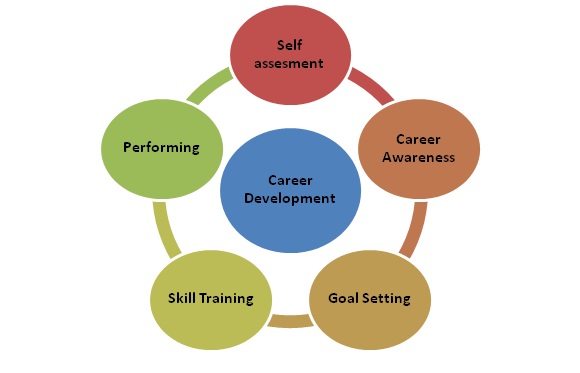
CHALLENGES FACING CAREER DEVELOPMENT
Too great an emphasis on career development and enhancement can be detrimental to organizational effectiveness. Employees with an extreme careerist orientation can become more concerned about their image than their performance. There are certain warning signs managers should watch for:
Because the barriers to advancement of women and minorities tend not to be obvious, they are difficult to identify and remove. The accounting firm Deloitte and Touche launched a long term initiative to lower the rate of turnover among female managers and to encourage the promotion of more women to partnership ranks. The initiative, prompted by the company’s Task Force on the Retention and Recruitment of Women, features company-wide training in workplace gender dynamics along with structured career planning and career development for women, succession planning, networking opportunities, and family-friendly work options.
Importance of Career Anchors
Often times companies claim they have the best interest of their employees at heart yet the reverse is often the case where companies tend to create systems that benefits the organization rather the employees.
Career Anchors help an individual in conceptualizing his own perceived career. It encompasses one’s core areas of competence, motives, and career values. Very often, this perceived career anchor goes against organizational career plans and employees develop a sense of dissonance or certain incongruity about their career plans. Therefore, many organizations seek to identify perceived career anchors of their employees to develop matching career development programmes.
CASES OF LEARNING AND DEVELOPMENT
IKEA has its own system of learning and trainings designed for a specific job position. You will get an introduction training as a new co-worker where you will learn how the company operates, what are the safety and security rules, customer friendly principles and our environmental approach. You will also get a mentor – a colleague who answers all your questions, shows you your department and introduces you to your colleagues. You will pass more trainings according to your training plan then.
Development talk is a friendly meeting with your manager at least once a year where you agree together where you would like to go and develop in a coming year. It can also be completely different from your current specialization. If you have a desire and prerequisites to move further, your manager will help you to choose appropriate procedures and trainings to reach your goal.
PFIZER DEVELOPMENT SYSTEM
Pfizer leaders and managers take an active role in developing colleagues and helping them fulfill their career goals:
References
In-text reference: ( Abushamsieh 2014 ). List of rerences: Abushamsieh Khalil. Training strategies,theories and types. URL : https://www.researchgate.net/publication/269165999_Training_strategies_theories_and_types Accessed 11.02.2020
In-text reference : Essays, UK. (November 2018). List of references : Major concepts of training development and learning.URL: https://www.ukessays.com/essays/management/major-concepts-of-training-development-and-learning-management-essay.php?vref=1 Accessed 11.02.2020
In-text reference: ( Ikea ). List of references: Ikea. Developement in Ikea. URL: https://ikea.jobs.cz/en/development-in-ikea/ Accessed 11.02.2020
In-text reference: ( Kelly2008) List of references : Kelly, Tim. 2008.Rio de Japano. URL : http://assignment4student.blogspot.com/2013/04/the-toyota-way-of-recruitment.html Accessed 11.02.2020
In-text reference : ( Niazi 2011). List of references : Niazi Abdus Sattar.Training and Development Strategy and Its Role in Organizational Performance.URL : https://doi.org/10.5296/jpag.v1i2.862 Accessed 11.02.2020
In-text reference :(Pfizer ). List of references : Our focus on employee growth and development.URL: https://careers.pfizer.com/en/our-focus-employee-growth-and-development Accessed 11.02.2020
RECRUITMENT AND SELECTION ( WEEK 6 )
Human resource management is a managerial process of acquiring and engaging the required workforce, appropriate for the job and concerned with developing, maintenance and utilization of work force.
There appear to be three broad categories of
general-level theory about HRM and a host of more specific and concrete theories about particular areas of policy and practice, such as quality, commitment and performance related pay. The three categories of theory can be labelled strategic, descriptive and
normative.
Strategic theories of HRM
These are primarily concerned with the relationship between a range of possible
external contingencies and HRM policy and practice. Some of the best-known UK research in this category has been reported by Hendry and Pettigrew (1990) whose main concern was to identify and classify key environmental influences on HRM. In their work, HRM policy and practice becomes, in a sense, the dependent variable, judged in
terms of how well it fits the context. The implicit but untested hypothesis is that a good
fit will be associated with superior performance.
Descriptive theories of HRM
The descriptive theories are best described by Beer and his colleagues from Harvard (Beer et al. 1985) and by Kochan, Katz and McKersie (1986) from MIT. In both cases, there is an attempt to capture the broad field and to address some of the interrelationships. For Beer at al. this means listing four broad areas of HRM policy and practice and four key outcomes. For Kochan and colleagues it entails a systems approach, describing the interrelationships between levels. Both are essentially descriptive, mapping the field and classifying inputs and outcomes.
A strength and a weakness in this respect is the emphasis on an open systems approach which may accurately capture an element of reality but fails to offer specificity. By providing conceptual maps of the field, these models do provide a broad-classification of the content of HRM and of a range of outcomes.
Normative theories of HRM
One of the best known examples of this approach is Walton’s work
on control and commitment (Walton, 1985). In presenting the contrast between the two
approaches to the management of human resources, he follows McGregor (1960) some
twenty-five years earlier in saying these are in one sense ideal types but in practice if
you wish to flourish you have no choice. He is prescribing a commitment strategy as the distinctive basis for HRM. The same general analysis can be found in the work of
Lawler (1986, 1992), although he uses the language of involvement rather than HRM.
According to (Guest, 1987) has attempted to capture some of the spirit of this approach by seeking to present it within a coherent framework, specifying some of the
links so that the resulting model can at least be tested – and possibly refuted .The central hypothesis is that if an integrated set of HRM practices is applied with a view
to achieving the normative goals of high commitment to the organization plus high
quality and flexibility, then higher worker performance will result. The assumption is
that this will have a positive impact on organizational performance. Unlike other approaches, this normative perspective argues that specific practices and specific HRM
goals will always be superior
These process of acquiring workforce is majorly the responsibility of the human resource manager who has to carefully put certain measures into consideration before acquiring a new employee . In some cases companies do have a standardized procedures in acquiring new employees while others still make references to old ways of acquiring new employees.
Nevertheless either a refined standardized method of hiring or obsolete , all forms of acquiring a new employee follows same principle of hiring process, hence : Recruitment-Selection-Orientation . However , these procedures are not as easy as it may seem because each process entails complex or multiple procedures in finding a right fit for the job. In addition , each process is bound by law and regulations in which every company must adhere to, to curb out any discriminating tendencies either racial,sex,age,disabilities etc among many others.
CHALLENGES FACING HIRING
Hiring a new employee may seem a great idea considering the need of increase in workforce , however the reality of getting the right candidate to do the job or person that fits the job description often are very tedious. Below are factors that may cause challenges in hiring :
Lack of quality candidates
It’s becoming increasingly difficult for companies to attract and engage qualified candidates for their open positions. It’s very much a candidate-driven market, meaning it’s often the companies who are competing, rather than the candidates.Employees who have decided to make the move will have applied to a number of different positions, and good candidates will be snatched up quickly.
Innovation vs Efficiency
HR managers continuously seek out new and improved tools to enhance the process of recruitment. While they often are ready to embrace new hiring techniques, striking a balance between expedience and effectiveness often holds them back. Inefficient hiring techniques can deter prime candidates.
Customization vs Consistency
Today’s recruiting technology is great at customization. Companies can customize everything from their application process to assessment test to help detect applicants that are good fit for the company. While most companies welcome this feature, when not implemented correctly it hinders research. Without consistent variables, researchers have a difficult time ascertaining hard data that hiring manager can trust.
STORIES OF ARTICLES THAT ARE RELATED TO RECRUITMENT AND SELECTION
The selecting process of Toyota is comprehensive since it determines the future talent pool of Toyota. The process is started with the source of information about job candidates. At this stage source of information of the candidate will be checked. This process is called screening process. The most common tool at Toyota for source of information is background checks. At the next stage candidate test is conducted. For this purpose both aptitude and achievement test are used. Some jobs at Toyota are highly technical. Thus, these tests are very important at the selection stage. At the aptitude test person’s capacity to learn or acquire skills are tested. The final step is reaching the selecting decision. The Toyota human resources policies will not allow to select any candidate who does not match with the Toyota culture.
References
In-text reference : ( Beer, Spector, Lawrence, Quinn Mills and Walton 1985). List of references : Beer, M., Spector, B., Lawrence, P., Quinn Mills, D. and Walton, R.1985. Human Resource Management: A General Manager’s Perspective. URL : https://www.tandfonline.com/doi/abs/10.1080/09585199000000038?journalCode=rijh20 Accessed 10.02.2020
In-tect reference: ( Gomez-Mejia, Balkin and Cardy 2016). List of references: Gomez-Mejia, L.R., Balkin, D.B. and Cardy, R.L. 2016. Managing Human Resources. Global Edition 8/E. Pearson. London. ISBN-10: 1292097248 • ISBN-13: 9781292097244. URL: http://ezproxy.haaga-helia.fi:2048/login?url=http://www.dawsonera.com/depp/reader/protected/external/AbstractView/S9781292097244 Accessed 10.02.2020
In-text reference : (Hendry and Pettigrew 1990) List of references : Hendry, C. and Pettigrew, A.1990. Human Resource Management: an agenda for the 1990s,
International Journal of Human Resource Management URL : https://www.tandfonline.com/doi/abs/10.1080/09585199000000038 Accessed 10.02.2020
In-text reference : (Lawler 1986) List of references : Lawler, E.E.1986. High Involvement Management, San Francisco . URL : https://eric.ed.gov/?id=ED314989 Accessed 10.02.2020
In-text reference: ( Kelly2008) List of references : Kelly, Tim. 2008.Rio de Japano. URL : http://assignment4student.blogspot.com/2013/04/the-toyota-way-of-recruitment.html Accessed 10.02.2020
In-text reference : ( McGregor 1960) List of references : McGregor, D. 1960.The Human Side of Enterprise, New York: McGraw-Hill Accessed 10.02.2020

The video posted below was about a local vodka distillery company looking to deal with growth and competition which attracted couple of issues with branding in global market, productions in volume, exportation in large quantities to 42 different countries they supply to , distribution units etc All these attributes narrows to how much risk they are willing to take to compete in global market
Learning objectives
Keywords
Matrix, Risk Management, Mitigate Risk, Alliances, Partnerships
Often times we use the word ‘ risk ‘ if we are uncertain about an attempt on something and this also relates to business as well. “Risks are usually defined by the adverse impact on profitability of several distinct sources of uncertainty. While the types and degree of risks an organization may be exposed to depend upon a number of factors such as its size, complexity business activities, volume etc” (SBP, 2003, p.1) . Over the last few decades, risk management has become an area of development in financial institutions. The area of financial services has been a business sector related to conditions of uncertainty. The financial sector is the most volatile in the current financial crisis. Activities within the financial sector are exposed to a large number of risks. For this reason, risk management is more important in the financial sector than in any other sectors (Carey, 2001).
Although the above stated quotes are mere definitions of risk but then again we would like to know what are the factors that truly compels a company to take risks ?

Prior before any analysis of export business ventures can commence, the company need to familiarize themselves with what they understand by ‘export business’. Export business can be defined in terms of products, customers or markets. A company processing major projects for customers in foreign markets will call these projects ‘export business’. Companies selling large numbers of standardized products through distribution partners abroad will define these partnerships as export business. The evaluation of export risks proceeds via an appraisal of the damage potential and the probabilities of occurrence of all risk types of relevance to the company (Hollmann 1984)
However , in order to venture into export business , risks should be taken into consideration and below are the methods to identify the risks in export business :
How to mitigate/reduce risk in export driven business?
For each risk you encounter, you and your organization will have to deal with it. A little forethought and work enable more options than just a major product recall or bankruptcy filing. Within your organization’s risk management framework there should be both aware of the various strategies along with understanding the guidelines for their implementation.
Although risks are often inevitable occurrences in export business , however there are certain measures to take to avoid risks :
CONCLUSION
There is no business venture or establishment that doesn’t come with risks , although the saying goes , ‘ the bigger the risks the bigger the rewards ‘ yet again it is imperative to take certain actions to assess risks that may involve in businesses before forging ahead to establish.
However , taking into consideration risks involved in business can prove helpful and implementing a system or a strategy to denote how to mitigate risks after establishment is greater.
References :
In-text reference: ( Carey 2001 ) List of references : Carey, A. 2001.“Effective risk management in financial institutions: the Turnbull approach”, Balance Sheet.URL : https://www.emerald.com/insight/content/doi/10.1108/09657960110696014/full/html Accessed 26.11.2019
In-text reference : ( Gleissner 2011) List of reference: Gleissner, W.2011. Grundlagen des Risikomanagements im Unternehmen, München .URL: https://www.vahlen.de/fachbuch/leseprobe/INH_GleissnerGrundlagendesRisik_978-3-8006-3767-6_2A_Leseprobe.pdf Accessed 26.11.2019
In-text reference : ( Hollmann, Mohammed-Zadeh 1984) List of reference : Hollmann, K. Mohammed-Zadeh, S.1984. Risk Management in Small Business, in: Journal of Small Business Management. Accessed 26.11,2019
In-text reference : ( SBP 2003) List of reference : SBP 2003. “Risk Management Guidelines for Commercial Banks & DFIs”, State Bank of Pakistan.URL :https://www.sbp.org.pk/about/riskmgm.pdf Accessed 26.11.2019
Relentlessly persistent
A daily selection of the best content published on WordPress, collected for you by humans who love to read.
Relentlessly persistent
Longreads : The best longform stories on the web
The latest news on WordPress.com and the WordPress community.

 johnenigma