
Introduction
A video interview was shown on YouTube, where Richard Lim was interviewed about a join clout between Tesco and Carrefour . Richard explained the purpose of this merger and the reason why this move is a ‘ Strategic alliance ‘ which would in turn strength both companies to be able to compete against other competitors in the market.
Learning objectives
- What are the effects of strategic alliances?
- What is the cause of food inflation?
Keywords
Suppliers, market share, food inflation, inorganic growth, theory of growth, theory of supply and demand
What are the effects of strategic alliances ?

Change is an inevitable occurrence in human history and in business wise it is quite very applicable . Change itself is remotely related to growth because it is the plan for most company to grow and that can not happen without change . For most companies , growth could be tough considering the challenges faced with their their competitors , some times they may not be able to meet the pace at which their competitors are going or the demands for their goods and service hence why some companies tend to form a strategic alliance .
In order to discuss further , first of what is ‘ Strategic alliance ‘ ? Strategic alliances are agreements between two or more independent companies to cooperate in the manufacturing, development, or sale of products and services or other business objectives.
The benefits of this alliance is great but then again before lamenting on these benefits there are also fear factors can comes before making any business alliance.
According to a survey made by Maria Martyak :
We’ve discussed with many of our members their fears and hesitations about being approached for an alliance. When considering entering into a strategic alliance, it can sometimes feel as if someone is trying to take over their business. They also find the operational and financial implications might seem hazy, and the work ahead too demanding.
Some of the concerns they expressed include:
- Loss of ownership in the business
- Loss of executive control over the project
- They associate a Strategic Alliance with M&A activity
- That a strategic alliance is too high level for their small business
Truthfully, strategic alliance can lead to growth for both parties. Slowly but surely, we are seeing these doubts erode as more business leaders become comfortable with the concept and the benefits of strategic alliances.
In addition ,
- Partners may misrepresent what they bring to the table (lie about competencies that they do not have).
- Partners may fail to commit resources and capabilities to the other partners.
- One partner may commit heavily to the alliance while the other partner does not.
- Partners may fail to use their complementary resources effectively.
Reasons for Strategic Alliances
For better comprehension for strategic alliances, three different product needs to be put into consideration , which are life cycles: Slow cycle, Standard cycle, and Fast cycle. The product life cycle is determined by the need to innovate and continually create new products in an industry . For instance, if we take into consideration the pharmaceutical industry, it operates a slow product life-cycle, while the software industry operates in a fast product life-cycle. For companies whose product falls in a different product life-cycle, the reasoning for strategic alliances are different:
1 Slow Cycle
In a slow cycle, the company’s competitive advantages are primarily focused on relatively long periods of time. The pharmaceutical industry operates in a slow product life cycle as the products are not developed yearly and patents last a long time.
Strategic alliances are formed to gain access to a restricted market, maintain market stability (setting product standards), and establishing a franchise in a new market.
2 Standard Cycle
In a standard cycle, the company are not concerned about the competitiveness of their product in the market lasting longer rather focused in launching a new product every few years
Strategic alliances are formed to gain market share, try to push out other companies, pool resources for large capital projects, establish economies of scale, and gain access to complementary resources.
3 Fast Cycle
In a fast cycle, the company’s competitive advantages are not protected and companies operating in a fast product life-cycle need to constantly develop new products/services to survive.
Strategic alliances are formed to speed up the development of new goods or services, share R&D expenses, streamline market penetration, and overcome uncertainty.
Below is a table by that shows market reactions to a strategic alliance.
AR = Abnormal returns
CARs = Cumulative Abnormal Returns

What is the cause of food inflation ?
Ordinarily we understand that, Inflation is a situation of a sustained increase in the general price level in an economy. Inflation means an increase in the cost of living as the price of goods and services rise .However , in correlation with food ,we need to know what is ‘ food inflation’ .?
Food inflation refers to the condition where by there exist increase in wholesale price index of essential food item (defined as food basket) relative to the general inflation or the consumer price index.
According to a journal written by Tejvan Pettinger :
When food prices rise in the developed world, it is an inconvenience, something to grumble about. But, when food prices rise in the developing world, it can make a difference between going hungry and getting enough to eat.
Food inflation is volatile. Agricultural prices tend to fluctuate because demand and supply are both inelastic and supply can vary due to the weather. However, despite the usual volatility, food prices seem to be showing a strong upward movement, reaching record highs in recent years.( Tejvan Pettinger 2016 )
What is Causing Food Inflation?
The diagrams below explains the trends to explain the causes of food inflation.
Diagram showing rising food prices:
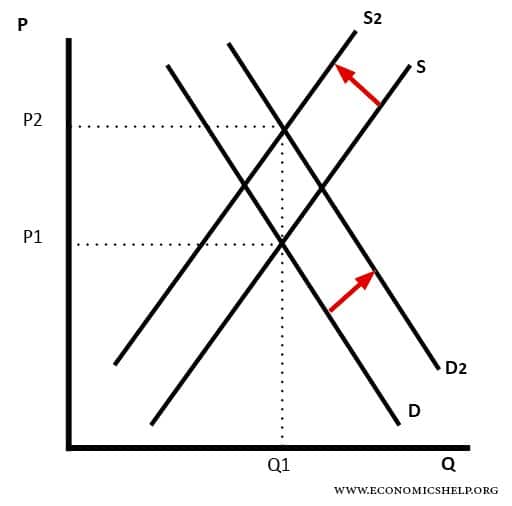
- There have been short-term supply constraints such as bad weather. However, there is also evidence of increasing long-term supply constraints such as loss of farming land due to global warming.
- Increased use of bio-fuels. Growing crops for energy rather than food production.
- Rising Demand. Rapid economic growth in China and India is increasing demand for more resource intensive foods. As incomes rise, people tend to spend a higher % of While on meat and dairy products. These require more intensive land cultivation. e.g. crops are used to feed cattle. Therefore the supply of crops for food has decreased.
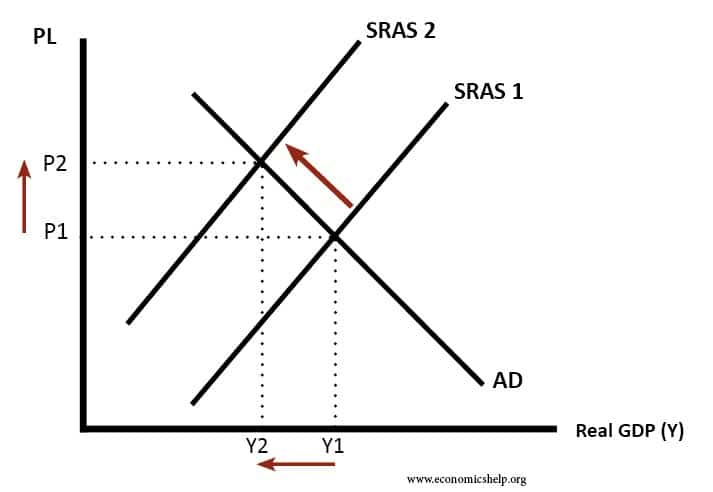
Cost-push inflation :
Cost-push inflation occurs when we experience rising prices due to higher costs of production and higher costs of raw materials. Cost-push inflation is determined by supply-side factors (cost-push inflation is different to demand-pull inflation which occurs due to aggregate demand growing faster than aggregate supply)
Cost-push inflation can lead to lower economic growth and often causes a fall in living standards, though it often proves to be temporary.
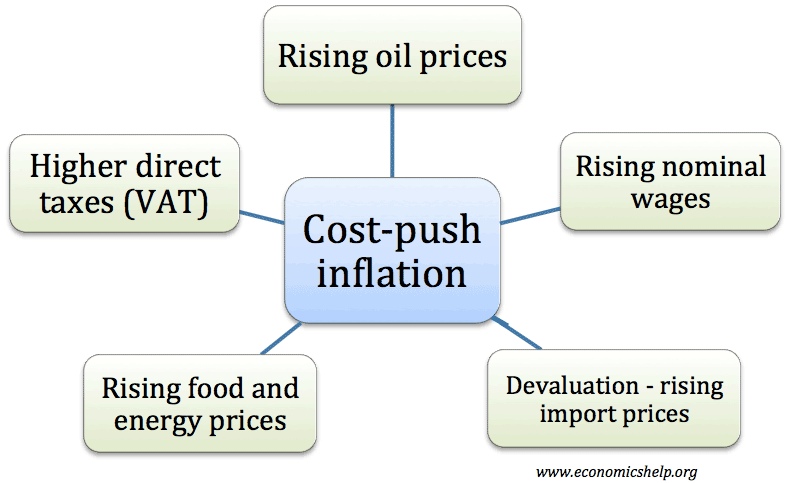
Causes of Cost-Push Inflation :
The diagram below shows the causes of Cost-Push Inflation
Demand-pull Inflation :
Demand-pull inflation is a period of inflation which arises from rapid growth in aggregate demand .
If aggregate demand (AD) rises faster than productive capacity (LRAS), then firms will respond by putting up prices, creating inflation.
- Inflation – a sustained increase in the price level.
- Demand-pull inflation – inflation caused by AD increasing faster than AS.
Demand-pull inflation means:
- Excess demand and ‘too much money chasing too few goods.’
- The economy is at full employment/full capacity.
- The economy will be growing at a rate faster than the long-run trend rate.
- A falling unemployment rate.
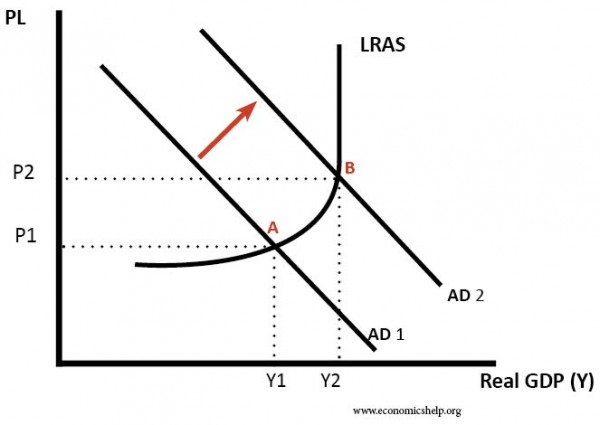
Causes of demand-pull inflation
- Lower interest rates. A cut in interest rates causes a rise in consumer spending and higher investment. This boost to demand causes a rise in AD and inflationary pressures.
- The rise in house prices. Rising house prices create a positive wealth effect and boost consumer spending. This leads to a rise in economic growth.
- Rising real wages. For example, unions bargaining for higher wage rates.
- Devaluation. Devaluation in the exchange rate increases domestic demand (exports cheaper, imports more expensive). Devaluation will also cause cost-push inflation (imports more
Other factors attributed to food inflation :
Supply Demand Equation : Since 1999, cereal production has risen very low , which has led to a fall in cereal stockpiles to historic lows. Growing population, changing diet habits and additional demand for the production of bio-fuels caused a rise in demand, while input factors like fuel, freight and fertilizer showed marked cost increases. Tight food markets have thus led to higher prices. Besides the physical supply and demand equation, part of the inflation was purely financial; the devaluation of the dollar made food inflation in this currency particularly pronounced.
Population Growth : Although the world population growth has been slowing from 1.26 percent (1996-2005) to 1.10 percent (projected 2006-2015) there will be a strong increase in absolute numbers. Annually 50 to 70 million people will be added to world population between now and 2030, most of them in Africa and Asia.
Change of Diets, Especially in Emerging Markets : It is not only the increasing number of people that has caused a surge in demand; the dramatic change in global diet patterns during the last four decades has also had an impact. The relative share of staple foods like cereals, roots and pulses has declined, while livestock products, fruit and vegetables with their higher needs of water and fertilizer have acquired increasing popularity because of rising living standards, urbanization and changes in relative prices. In recent years, this trend has been particularly pronounced in emerging markets like China and India, which in turn could lead to more imports and lesser exports by these countries in the future.
Conclusion
Strategic alliance would bolster the market presence of jointly formed company giving a better competitive advantage but may also create issues of hierarchy and devotion . There has been cases where both companies are expected to contribute to the success of the merger but then find one party contributing more than the other . It may often times create distrust but if these impediments can be overcome then the purpose of the merger will be achieved.
Supply and demand plays a huge role in food inflation as do other factors but then again if the government of every nation would dedicate resources to developing agricultural produce in high quantity to equate the demands , this can somewhat create a balance to reduce food inflation regardless of other factors.
References
In-text reference: (Martyak 2014) List of references: Martyak, M. 2014. Strategic alliance: How they can benefit your business.URL : https://www.powerlinx.com/blog/what-are-strategic-alliances/ Accessed 20.11.2019
In-text reference: (Marciukaityte, Rosekelley, Wang 2009) List of references : Marciukaityte, D. , Rosekelley, K.& Wang,H. 2009. Strategic alliances by financial service firms. URL: https://www.deepdyve.com/lp/elsevier/strategic-alliances-by-financial-services-firms-L5FbH0YsNF?articleList=%2Fsearch%3Fquery%3DWhat%2Bare%2Bthe%2Beffects%2Bof%2Bstrategic%2Balliances Accessed 20.11.2019
In-text reference: ( Pettinger 2017) List of references : Pettinger, T. 2017. Food Inflation. URL : https://www.economicshelp.org/blog/2578/economics/food-inflation/. Accessed 20.11.2019
In-text reference 😦 Woertz ,Pradhan & Biberovic , Koch 2008) List of references : Woertz, E.,Pradhan,S.,Biberovic,N. & Koch,C. 2008. Food Inflation in the GCC Countries. URL: https://s3.amazonaws.com/academia.edu.documents/8465651/food_inflation_3609.pdf?response-content-disposition=inline%3B%20filename%3DFood_Inflation_in_the_GCC_Countries.pdf&X-Amz-Algorithm=AWS4-HMAC-SHA256&X-Amz-Credential=AKIAIWOWYYGZ2Y53UL3A%2F20191120%2Fus-east-1%2Fs3%2Faws4_request&X-Amz-Date=20191120T222607Z&X-Amz-Expires=3600&X-Amz-SignedHeaders=host&X-Amz-Signature=64ebb0f337f045bb9d204ccb72f7e49e623f51726836442da43c2e28db033143. Accessed 20.11.2019

 johnenigma